
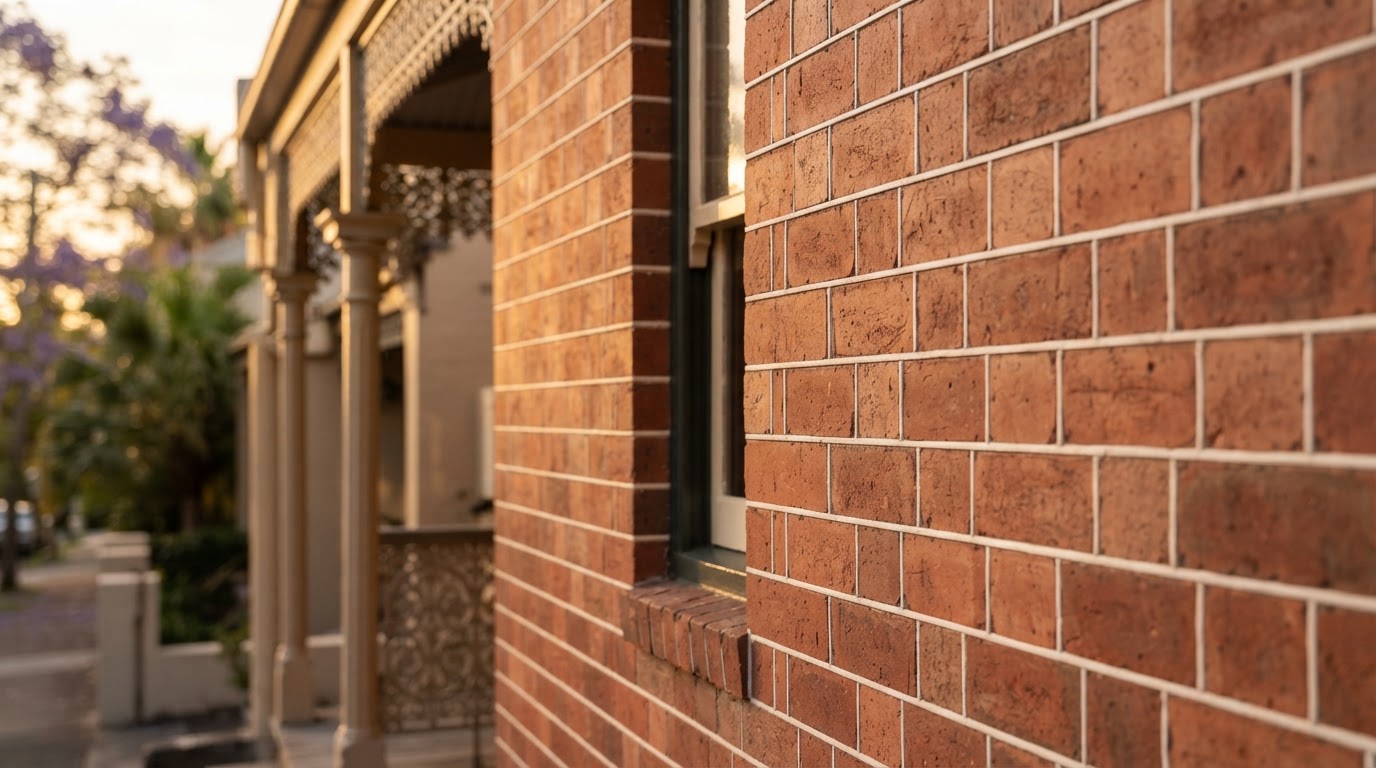
Tuckpointing in Sydney for period and heritage homes
Specialists in tuckpointing on period and heritage-listed homes across Greater Sydney. You deal directly with Troy — the person who quotes the job is the person who does the work.
If the mortar lines on your brick facade have gone soft, stained or worn away, tuckpointing is the traditional finish that brings them back. Heritage Master Builders restores tuckpointing on period homes across Greater Sydney. You deal directly with Troy, the owner-operator who quotes the work and carries it out.
What is tuckpointing?
Tuckpointing is a fine finishing technique used on many of Sydney’s older brick homes. Failed mortar is carefully raked out and replaced with two contrasting mortars: a flush background, usually matched close to the brick colour, and a thin, neatly tooled line. That line creates the impression of crisp, straight joints, even where the original bricks are a little irregular.
It is the look on well-kept Federation and Victorian facades. Our projects gallery shows this finish on Federation tuckpointing in Concord, with related period work in Haberfield, Drummoyne, Ashfield and Rose Bay.
Tuckpointing and repointing are not the same
Repointing is the structural repair: decayed mortar comes out and fresh mortar goes in so the wall is sound and weather-tight again. Tuckpointing goes a step further. After the joint is filled and flushed, the contrasting line is applied by hand to restore the original decorative finish.
Most heritage jobs need both. If the facade was originally tuckpointed — common on better-quality late nineteenth and early twentieth-century brickwork — a plain repoint will make it sound, but it will not look right. Troy will tell you honestly which finish suits your building, including when a broader heritage brick restoration is the better path.
Signs your brickwork needs tuckpointing
Look closely at the joints, especially on the front facade, verandah piers and chimneys:
- The fine contrasting line has worn away, leaving a flat or blotchy joint
- Mortar is crumbling, cracked, powdery, or recessed so you can scrape it out with a key
- Gaps have opened between the bricks, or later cement sits proud and cuts across the original lines
- Damp patches are appearing on internal walls near the same elevation
If the mortar is soft, missing or recessed by more than about 5mm, the wall needs attention before moisture reaches the bricks or the framing behind them.
How we tuckpoint a wall
The work is careful and methodical, with no shortcuts that chip historic brick edges. Troy inspects the mortar, bricks and access, then provides a free, no-obligation quote with no call-out fee. Failed mortar is raked out to a sound depth by hand, so the brick edges are protected. Damaged bricks are dealt with first. Joints are refilled with a flush mortar matched to your bricks and to the age of the wall, including lime mortar where the building calls for it. A thin contrasting line is then tooled on by hand, and the site is left tidy.
Lime mortar or cement?
Many older Sydney houses were built with lime mortar, which is softer and more breathable than modern cement. Heritage guidance in NSW is that lime joints should be repointed with lime. Hard cement in a lime wall can trap moisture and salts so they escape through the bricks, which can damage the masonry.
We use period-appropriate mortars, including lime, where the building needs them. If a later cement repair has already been added, Troy will explain what he finds and what he recommends.
Heritage homes and council approval
Heritage and period properties are our specialty, including Victorian, Federation and Californian bungalow brickwork. If your home is a heritage item, sits in a heritage conservation area, or is on the State Heritage Register, check with your local council before work starts.
Like-for-like tuckpointing with traditional materials is often treated as minor maintenance, but many NSW councils still want written confirmation first under clause 5.10 of the local planning scheme. Properties on the State Heritage Register may also need approval under the Heritage Act 1977. Rules vary, and this is general information, not planning advice.
How long does tuckpointing last?
When it is done properly with a breathable lime or heritage-compatible mortar, quality tuckpointing lasts for decades. In Sydney’s climate, properly restored joints typically protect the brickwork and keep their appearance for 30 to 50+ years, depending on exposure, maintenance and the mortar used.
What tuckpointing costs in Sydney
We do not publish a single rate, because a ground-floor patch and a two-storey terrace facade are not the same job. The quote usually depends on the area of wall, height and access (including scaffolding), the condition of the mortar and bricks, any repairs needed first, whether the base mortar should be lime, and the extra time in the hand-finished line.
A written quote is free, with no obligation and no call-out fee. Send your suburb and a few photos through the contact form, or call Troy on 0424 259 620.
Tuckpointing near you, across Greater Sydney
We are based in the Inner West and we come to you. Coverage includes Haberfield, Ashfield, Summer Hill, Leichhardt, Balmain, Paddington and the other suburbs on our service area page. Start with photos and a suburb — Troy will tell you whether tuckpointing is the right finish, or whether repointing or a wider heritage brick restoration is the better path.